VALORANT 13.06: The Major Update and What to Do Next
Get oriented in VALORANT 13.06, then build a focused first-session review with practical questions, useful notes and clear next steps for your play.
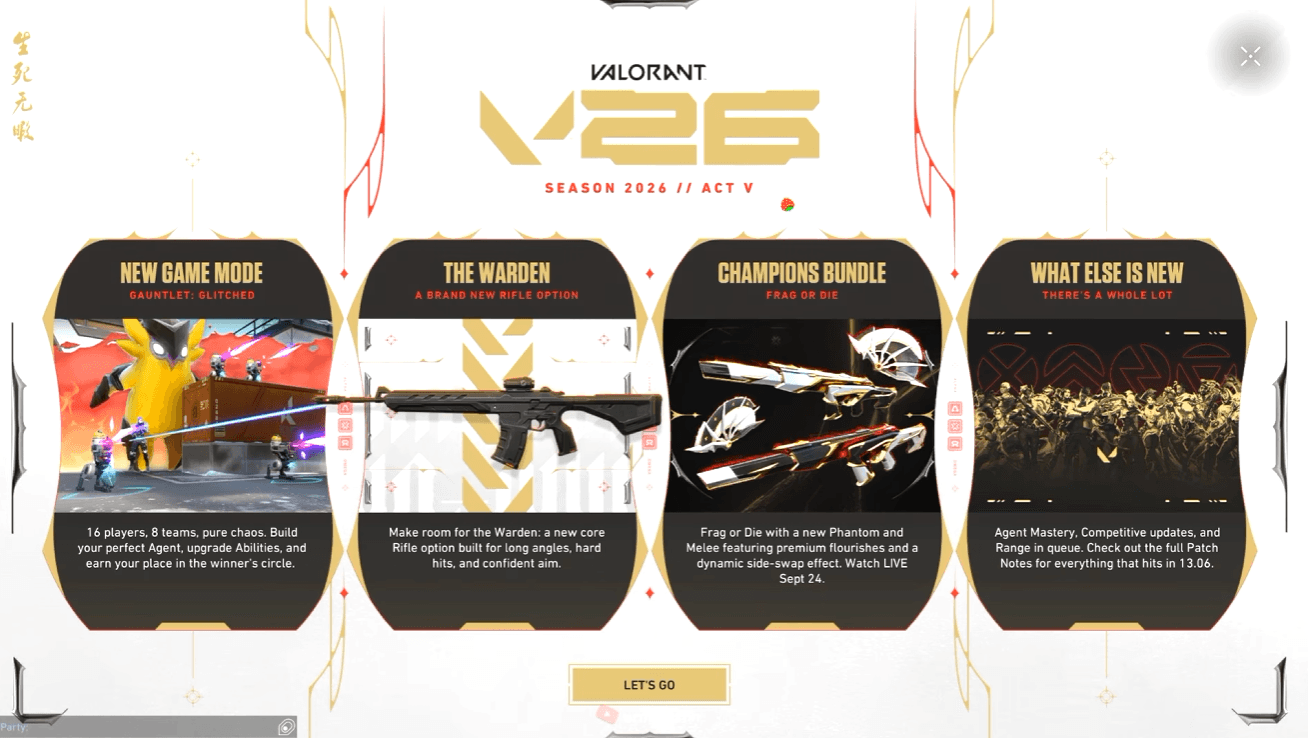
VALORANT patch 13.06 arrived September 22, 2026, bringing the Warden rifle, Gauntlet: Glitched, Agent Mastery and a redesigned competitive experience. Riot's patch notes
For returning players, the useful question is where to start. You do not need to investigate every new feature before playing. This guide separates the essentials from a suggested first-session routine: find your bearings, play with one clear intention, then review a decision you can change.
The main changes at a glance
| Area | What changed |
|---|---|
| Client | Home and Lobby merge into one hub. |
| Match feedback | Performance Score replaces ACS: a 0–500 measure beyond kills and damage, determining MVP and scoreboard order in Competitive, Unrated, Swiftplay and Premier. |
| Personal records | Accolades track Act and lifetime bests in Competitive/Premier, starting without historical matches. |
| Ranked history | Rank Legacy records ranks reached; each rank's counter advances once per three-Act block, excluding demotions. |
| Warm-up | Range access while queuing excludes Premier, Deathmatch and modes without Agent Select. |
Read our Warden guide for weapon statistics, mode rules and progression details. Full patch notes
Start with one question you can answer
Our suggestion for your first session is simple: choose a question before you queue. Make it about a decision, rather than a target result. “Will I win?” leaves you with little to review. “What information will I check before committing to a fight?” gives you something specific to look for afterward.
Keep that question visible in a short note. You might focus on whether you communicated a plan before acting, whether you understood a teammate's intention, or whether you changed your decision after receiving new information. Choose one. Trying to monitor everything usually produces an unfocused review.
Treat this as a personal experiment, not another task list to complete perfectly. If the chosen question never comes up, record that and pick a more relevant situation next time. The point is to collect a useful example, not force a lesson out of every match.
Review the decision behind the result
After the game, resist writing only “good match” or “bad match.” Those labels describe how the result felt. They do not tell you what to repeat or adjust. Instead, select one moment you remember clearly and reconstruct the information you had at the time.
For example, imagine you planned to move with a teammate but acted before confirming that they were ready. In your review, separate the intention from the execution. Was the plan unclear? Did you hear a call and interpret it differently? Did you notice something that made you abandon the plan? This is a hypothetical review prompt, not a claim about how any scoring system evaluates the play.
Try this compact note:
- Situation: What were you trying to accomplish?
- Information: What did you know before acting?
- Decision: What did you choose, and why?
- Adjustment: What would you check or communicate next time?
If you have a recording, use it to test your memory. If you do not, keep the note provisional. Do not turn an uncertain recollection into a confident explanation. A useful review can end with “I need another example.”
Your next experiment should be small enough to recognize during play. “Communicate my intention before moving” is actionable. “Become more consistent” needs another step before it becomes useful. For a specific skill you want to investigate, browse the Roadmap guides and choose one relevant lesson.
Fair-play updates: know what to report
Riot has expanded voice-abuse detection for Spanish, Portuguese and Korean. Its reported doubling of detected and penalized incidents covers improvements over the preceding year, rather than a result measured from this patch alone. Report abusive voice communication through Voice Comms Abuse; responding with abuse can also lead to penalties. Playing with Respect
Anti-boosting is continuing work, not a system first introduced this week: the detection rollout began with 13.01. Riot distinguishes normal play with friends from manipulation and provides a Rank Manipulation reporting category. Playing Fair
The September anti-boosting report focuses on shared or purchased accounts and manipulated ranked gains. Its 296,416 actioned-account total covers both VALORANT and League of Legends. Legitimate, self-created, self-leveled and unshared alternate accounts are not blanket targets; using accounts to boost others remains a separate issue. Vanguard: Anti-Boost, Pro-Skill
For your own review, keep observations and suspicions separate. Write down what happened without declaring that an opponent's strong result proves misconduct. Use the relevant reporting channel when appropriate, then return your session notes to the choices you could control. That keeps a frustrating match from becoming an explanation for every mistake.
A platform check for Australia and New Zealand
The regional console launch was September 23 at 10 AM AEST on PlayStation 5 and Xbox Series X|S. Xbox and PlayStation players can play together; console and PC cannot. Account progression and purchases carry between platforms, and PlayStation Plus or Game Pass is not required. The announcement's September 24 publication date is distinct from its stated launch time. Riot's console announcement
Keep upcoming features separate from today's session
Map Rating is planned for 13.08; Competitive Flex and Radiant updates for 14.00. Riot's patch notes
You do not need a perfect first session after an update. Leave it with one decision you understand better and one adjustment worth testing. That gives your next game a purpose beyond checking every new menu.