VALORANT Warden Guide to Stats, Skins and Practice
Explore VALORANT Warden stats and the Galleria skin, compare rifle practice plans, and watch our Range aim routine, with official Riot sources.
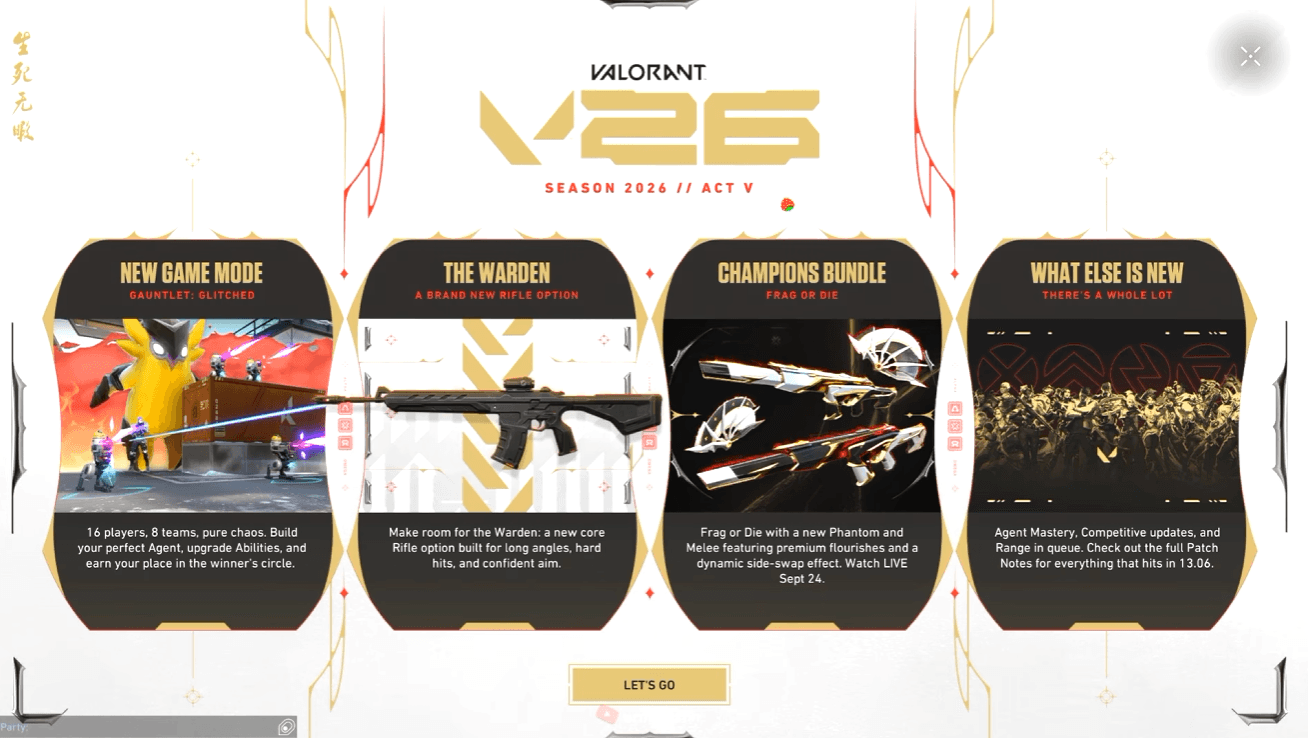
Should the Warden become part of your rifle rotation? Which parts of the update deserve your practice time? This guide separates a compact reference to Riot’s announced changes from Roadmap’s suggested exercises. Use the facts to understand the update and the exercises to decide what is useful for your own play.
VALORANT patch 13.06: Warden stats
Riot released patch 13.06 on September 22, 2026, introducing Warden, Gauntlet: Glitched and Agent Mastery. The Warden joins Vandal and Phantom at 2,900 credits.
| Specification | Warden |
|---|---|
| Category | Automatic rifle |
| Scope | 2× |
| Magazine / reserve | 18 / 36 |
| Body damage | 50, all distances |
| Head / leg damage | 200 / 42 |
| Fire rate / reload timing | 6.5 / 2.5 |
| Equip timing: normal / fast / instant | 1.0 / 0.6 / 0.2 |
| Penetration | Medium |
The timing and rate entries preserve Riot’s published values; its table does not label their units. Treat this as a specification reference, not a measured comparison of weapon performance.
Our suggested next question is practical: which decision do you want to improve? Pick a situation you can describe, such as holding an angle, choosing when to disengage, or resetting after a missed shot. That gives your first session a purpose beyond trying a new purchase.
A closer look at the Galleria Warden skin
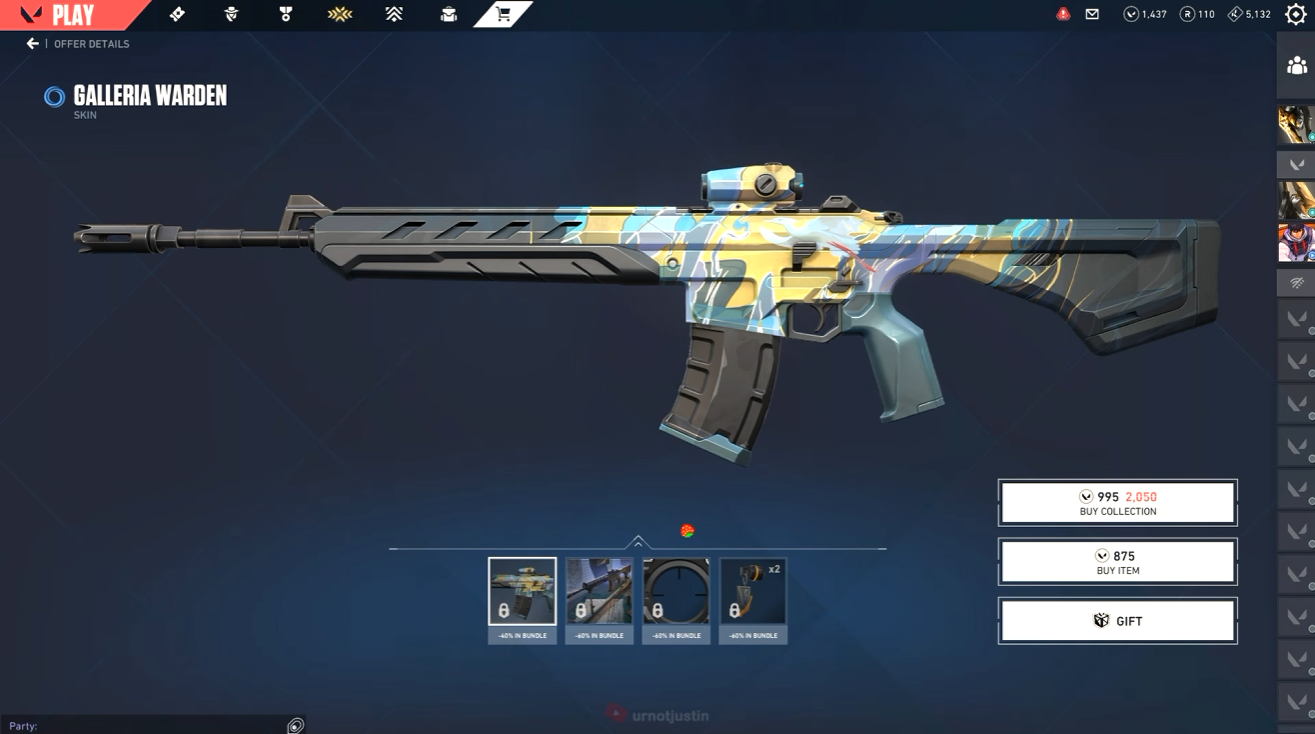
Galleria Warden, shown in the weapon preview.
The blue, cream and gold finish is visible across the rifle and scope. The first-person screenshot below shows the same design in the Range. Use these views to explore its appearance, then use the comparison exercise to evaluate your own handling of the rifle.
Warden vs Vandal and Phantom: a fair comparison
We suggest a small, repeatable comparison before changing your usual buying habits. This exercise is for learning about your own decisions; it cannot establish a weapon tier list.
- Choose a comfortable practice location, a target and a fixed starting position. Write down the distance or a visible landmark so you can reproduce it.
- Give each rifle the same number of attempts. Ten attempts per rifle is an optional starting point, not a statistically validated sample size.
- Keep your starting position, target and intended action consistent. Alternate which rifle goes first across blocks so your favourite does not always get your freshest attempts.
- Record hits and misses manually. Add a short note when you lose your planned position, interrupt an attempt to reload, or abandon the shot. Keep those attempts in your notes.
- Change one condition for the next block. For example, choose a different starting distance while keeping the same target and action. Avoid changing several conditions at once and guessing which one mattered.
For match practice, our suggestion is to discuss the team’s purchase plan first and test only when the buy makes sense. Review the decision afterward: did you choose the fight you intended, or did the situation change?
Try writing a conclusion as a question for the next session: “Can I repeat that decision under pressure?” That is more useful than declaring the Warden better after one strong game. If your notes are inconsistent, keep your familiar routine while you gather more observations.
Watch our Range aim-training routine
For a guided practice reference, watch Roadmap coach Konpeki's This Aim Routine Will Finally Fix Your Aim (Range Only). It complements the comparison exercise above; the video is a general aim-training resource, not a Warden-specific benchmark.
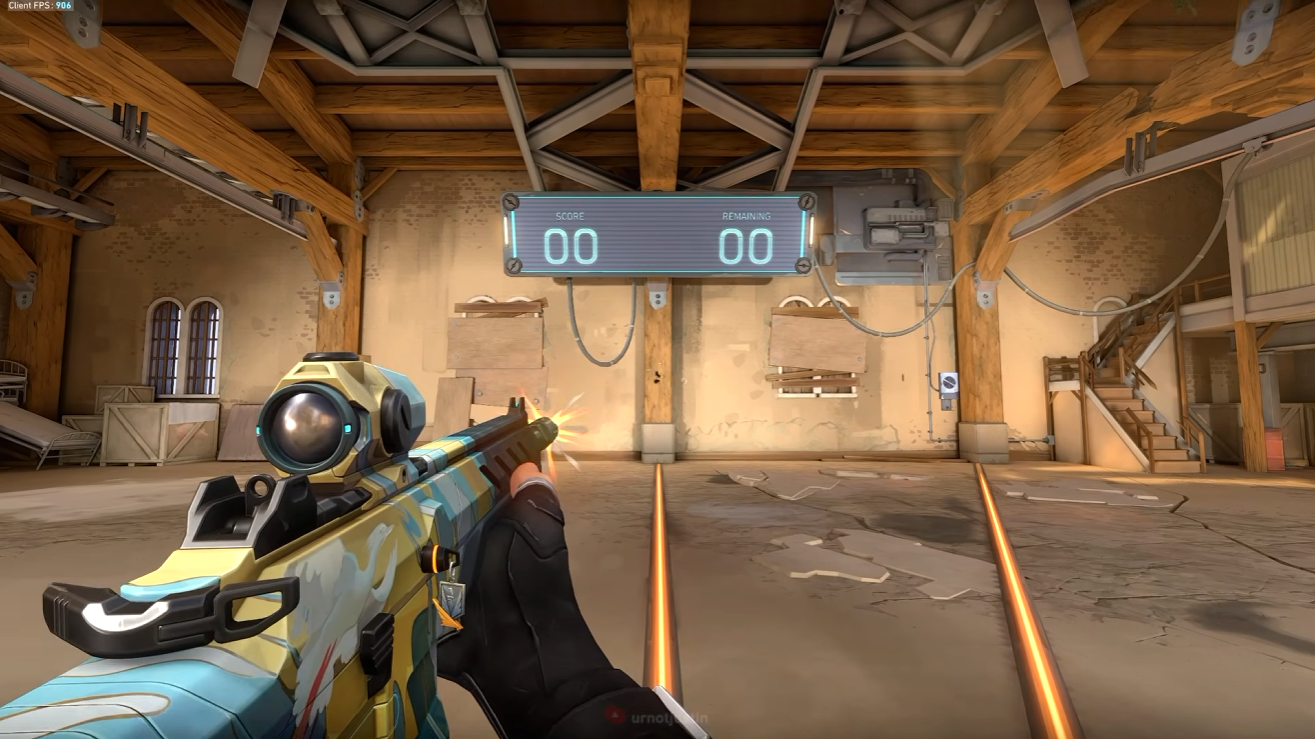
The Galleria Warden in the Practice Range, viewed from the player's perspective.
Choose one question before watching, then write one adjustment to test. Avoid stacking a new rifle, a new sensitivity and a different warm-up into the same session if you want your notes to explain what changed.
Review one decision, not just the result
Our suggested follow-up is to select one successful fight and one unsuccessful fight from the session. Pause each clip before the important decision. Note what you knew then, what you intended to do if the first attempt failed, and whether you communicated the plan. Keep information learned from the replay separate from what was available during play.
Write one change to test next time. A log with the date, rifle, situation, decision and next experiment is enough to begin; this is our proposed review format, not a claim of measured improvement.
Gauntlet: Glitched rules and a suggested duo exercise
Gauntlet: Glitched is a temporary mode with eight pairs across four arenas. Solo entry is supported. Rounds pit two pairs against each other; defeats drain team health, with elimination at zero. Later stages change weapons and increase the health penalty. Between rounds, players select random cross-Agent abilities or upgrade them through three levels. Level-two upgrades can randomly glitch. Eliminated pairs may leave immediately. The cited notes provide no closing date.
Our suggested exercise is a short communication review with your partner. Before a round, agree on one plan: who initiates, what the partner will watch, and what call means the plan should change. Use the abilities actually available to each of you; do not build the exercise around receiving a particular option.
Afterward, each player identifies one decision they would keep and one they would change. Compare what you believed your partner was doing with what they intended. For the next round, choose a single communication change to try.
We recommend keeping that conversation brief and specific. “Call before we change direction” gives you a clearer experiment than “communicate better.” Treat any lesson as something to test in your usual play, rather than assuming a different format proves what will work in ranked.
VALORANT Agent Mastery: progression and practice goals
Riot’s support guide lists Competitive, Unrated, Swiftplay, Spike Rush, Team Deathmatch and Premier as Mastery Point sources. Points belong to the Agent used; match duration influences gains, with bonuses for wins and strong performance.
Act Levels reset each Act, while Lifetime Levels persist and rise alongside earned Act Levels. Portrait upgrades survive one additional Act. The system began at zero without converting older playtime. Lifetime progression opens access to rewards bought with Kingdom Credits, and Agent IDs let players personalise displayed statistics and visuals.
Our suggested approach is to keep a practice goal separate from a progression goal. For example, choose an Agent you want to spend time with, then select one decision to review: whether you used information before committing, communicated a change of plan, or supported the action your team agreed on.
For the practice goal, record a specific moment and your reasoning. For the progression goal, check the game’s displayed progress. We would not use the second as a substitute for the first: your review should explain what you would do next time, rather than simply pointing to a badge.
If you switch Agents, revisit the practice question too. Keep the goal relevant to the situations you are trying to understand instead of turning every session into a checklist of rewards.
Does choosing a different Agent mean abandoning your goal?
Our suggestion is to define the goal as a decision you want to understand, then adapt the exercise to the Agent you choose. For example, review when you acted on information and whether your team understood the plan. Keep the progression record as a separate reference instead of using it to grade that decision.
What should I do next?
Choose one exercise from this guide, write down what you hope to learn, and compare that intention with your next review. Include both successes and mistakes. We recommend narrowing the question whenever your notes become too broad to suggest a concrete next action.
For the broader competitive changes, read VALORANT 13.06 and what to check before your next ranked game. Browse our VALORANT guides for more coaching topics. If you want help identifying a useful practice priority, explore Roadmap coaching.